Apr 12
25
SMX Toronto Live Blogging
Welcome to Social Media Metrics: Drive with Care, Alan K’necht’s morning session at eMetrics Marketing Optimization Summit Toronto 2012!
Alan will be getting started any minute… stay tuned for live blog coverage from the event.
11.38
Content is your oxygen; this is what you’re going to fan your flames with.
Measuring Oxygen:
- How often are we publishing to social?
- How often are others in our space putting out content?
- Examine quality: are we generating page views, comments, etc?
11.37
Focus on:
- Topical scores
- Top influencers within a topic
- Top vote (+K) getter within a topic
- Active participation within a topic
We are measuring the quality of those within the head count, not the quantity.
11.36
Keys to Measuring Fuel:
Ignore the pure head count.
Partially ignore raw scores; metrics like Klout are meaningless on their own.
11.35
How many of your fans and followers are thought leaders? How engaged are they?
07.35
Dan Linton, Marketing Science Group Director from digital marketing agency Critical Mass is introducing Alan K’necht, who is talking social media analytics and the tools you can use to measure them.
In The Last Original Idea, Alan had discussed the difference between online social marketing vs. offline social marketing. Social marketing is not a new concept; we’ve been making recommendations to friends and using word of mouth for centuries. Now, we are able to do it online.
He likens social marketing to the atmosphere around a bonfire. You’re connecting, sharing, enjoying the company of others. If the fire dwindles out, people will leave. If it’s too large, people will have to back up and can no longer connect with one another. We have to make sure our fire is the right size.
It can be difficult to convince employers that a larger fire is not necessarily a better one.
Fire requires 3 things to be successful. What is your fuel source in social marketing? This is your followers, fans, head count, or contacts. Remember when we used to judge website performance by “hits?” Follower counts are the “hits” of social. They’re a useless metric.
20.01
That’s it for the 1st MediaBistro Socialize Conference in Toronto.
20.00
Closing Keynote: Gesturing Our Way through Social Media by VINCENT JOHN VINCENT Co-CEO, President, Co-founder, GestureTek Inc.
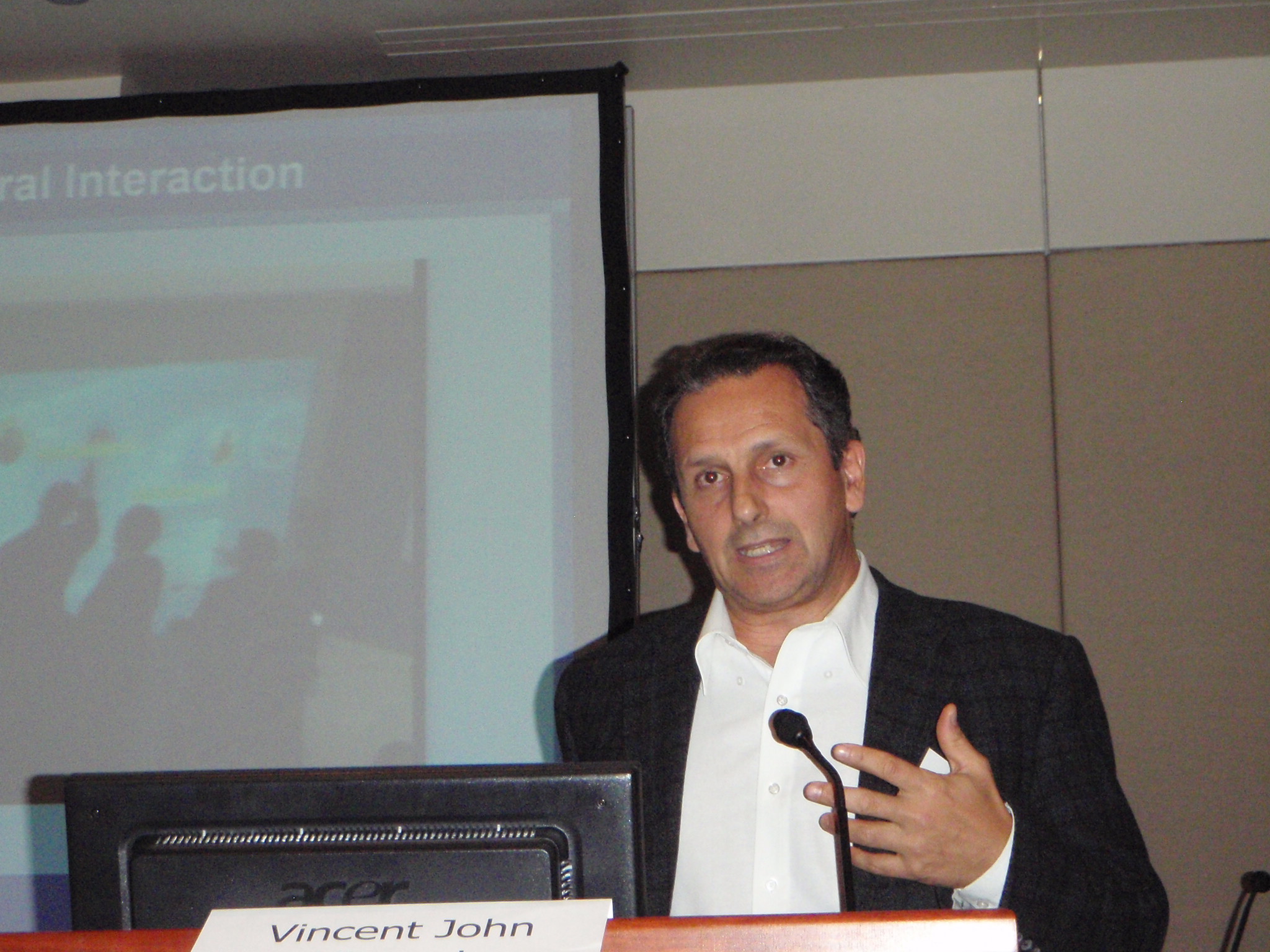
Closing Keynote Vincent John Vincent - Gesturing Our Way through Social Media
The revolution we have seen in the last decade of social media has not just been about us having access to the creation of an endless stream of information and experiences that we can funnel into or out of our lives. It has also been about a proliferation of gadgets, devices, and displays that either surround us in our homes and urban environments, or that we carry on us, with which we can use to interact with this cornucopia of social media. Into this milieu comes the rise of gesture controlled technologies, which hopefully will allow us a more natural user interface with which to reach deeper and more dynamically into this networked cyber world, as we interact with the growing availability of social media experiences. Join us for a rare inside peek at how Gesture Controlled technologies like multi-touch and off screen point and control gesture analysis are beginning to be used today for social media and social gaming, and what will it mean for the future.
With the rise of personal computers, information became more democratized. The proliferation of tools we can access this information with has proliferated rapidly. The total number of connected devices right now on the net is 3.5Billion.
The other aspect of SoMe, in terms of human exp. is the nature of how we interface/interact with that media is where gesture control comes in b/c they allow us to reach deeper. Gesture control runs the gamut from swiping to full body gesture control.
The progress of gesture control to the forefront of computing has only been natural due to our nature. Our computers came from calculators while full body immersive control came from the “dancer in us all.” It was this vision that led VJV to create a technology that would enhance our embodiement.
1st decided to create something that’s a new artistic medium which let’s users perform and let the artist be un-encumbered. Thought of the video camera as the natural interface and created full body immersive control.
It’s been 25 yrs since evangelizing full body control. Back then had to find a computer they could afford to create the technology. Amazing thing is that this computer let them do this in real-time (1995).
Created immersive video games and 3d depth cameras they created which are the basis for the Kinect 3d cameras of today. Interested physios in this tech. These types of apps are already showing up on the Kinect today but also getting the metrics.
A lot of what we will be seeing in the future as we develop our virtual sense will be video posts of what people achieve in virtual worlds.
This ability to interact in virtual sets will be the kind of video content people will create in the future. We don’t all have to be in the same place to be in the same virtual world.
The WWW will become a 3d world we can enter in the future. We will be able to experience the media live in itself. At some point in time someone will create a Second Life experience where the consumer can be inside their Second Life character.
Got lucky and found angel investors that allowed them to create all sort of technology and licensed patents for Sony’s EYE toy, Xbox Kinect, Hasbro ION, etc.
Gesture control/immersive gaming on mobile phones will allow us to experience our phones differently. Created interactive surfaces that were deployed in museums, etc. and brought signage into the digital realm which is great since nothing gets broken. In 2003 started pioneering multi-touch and many other companies were working on it as well. Used and pioneered cameras to control multi-touch from a distance.
Use gesture control to attract customers in but then get info from them through a touch screen. SoMe is growing rapidly in the virtual signage world.
Interesting uses of virtual signage with SoME. Interactive touch window with twitter feeds used by Tourism Canada in the US. Another example is the NY Visitor Center where they created multi-touch tables with google maps to point out locations they have chosen to visit in NY and get that info on their phones when they leave.
3D gesture and mobile phone control for Sprint in an airport.
Content in king in digital signage since people are traveling and distracted so engagement is hard to get. Great example of a sea of blocks that were twitter images and when you clicked on it, the twitter feed came up
Invented 3D gesture control in 2000 and there really wasn’t an affordable camera until Kinect came out and Prime Sense camera for PC’s so there has been an explosion of 3D gesture control. Fortune 500 companies are creating 3D gesture control strategies because it’s become increasingly important.
3D gesture control in our living room/media centre is the future. Companies are looking at whole portals in our homes and offices in the future. Try Mirror is a company that uses Kinect to measure clothes that will flow well on you.
Soon we will see 3D gesture control coming to our mobile devices through stereo-ultrasound, etc. whatever is cheaper to do so it can be mass market. They’ve been working with car manufacturers to do gesture control in cars. Flying toy helicopters through gesture control with the Kinect.
Video of Augmented Social Control gone too far in the future on Vimeo by Keiichi Matsuda.
We are just at the beginning, in fact the 3D cameras out today are very low resolution but the 3D depth camera’s will continue becoming higher in resolution so they will be able to detect our movements better.
Alan – we are in the infancy of the online social media space. Imagine where we are in 25 years. Think about your audience and whether you need to integrate gesture control.
19.08
Mobile, Social & Local: The 3-Way Intersection of Future Commerce
As smartphone penetration crosses the 30 percent threshold, consumers are doing all kind of things with mobile devices: checking-in, scanning barcodes, posting to facebook, and sharing images. How does mobility boost social engagement? How does location relevance boost user intent? And most importantly, how are these factors colliding to present opportunities for product developers, media companies and marketers to engage audiences in ways they never have before? This panel of industry leaders will dive into these seminal issues.
PANEL:
AARON KRONIS Senior, Search Engine Optimization and Social Media Analyst, Portent, Inc.
RAMI LAMA Director of Marketing Strategy-Mobile, SapientNitro.
ISABELLE PAIN Publisher Relations Manager, Flurry, Inc.
SUSIE PARKER Owner, SPARKER Strategy Group
DAWN WENTZELL Project Manager, Mobile Technology, SpeakFeel Corporation
ALAN K’NECHT Founding Partner, Digital Media Always (moderator)
Todd Tweedy is moderating through Skype
AL: Interesting stats on teens who access the net through mobile devices only.
AL: what should business do to embrace mobile better? Should they focus on all the mobile devices or just one?
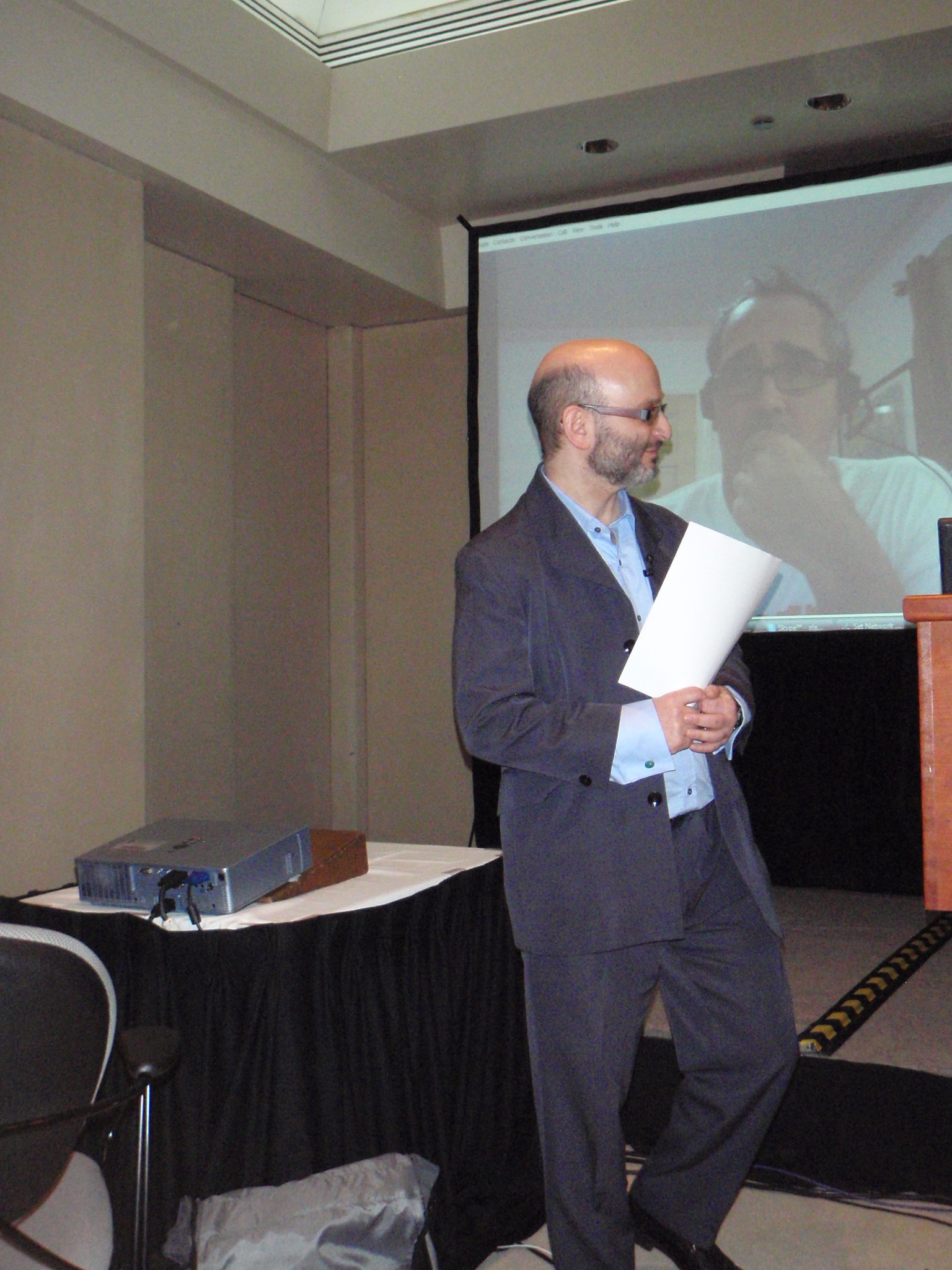
Todd Tweety (via Skype) and Alan K'necht moderating at Socialize
TODD: Companies don’t understand intersection of SoLoMo. Start with why you got into social and go from there into mobile.
DW: Mobile is an afterthought. For most SMB’s mobile is not their main concern but it should be. Every business needs to think about it even if it’s just the most basic contact info and then address tablet users since tablet users use it from their couch and convert/purchase more. Need to think if a mobile app will help their customers engage their brand further.
Todd: how do you advise your clients to use SoLoMo?
SP: My site is new and we went into the design process thinking about mobile from the beginning and this is what I tell clients.
Todd: rami what tips do you give?
Rami: You need a marketing, ecommerce strategy before a mobile strategy. Look at the tech and platforms that they use to reach people and then get into tactical. You need to experience first and the frame of mind of the user when they are experiencing your content/brand/product. To touch on point with local and global which in my opinion are the same b/c it’s talking to me no matter where I am.
Todd:
AK: Need to make sure your site look good on a phone. into responsive web design now where you just worry about width.
Rami: it’s becoming complex b/c your tv and car will do it. You need to look at multichannel instead of just mobile
Todd: what split are you seeing out there b/w platforms
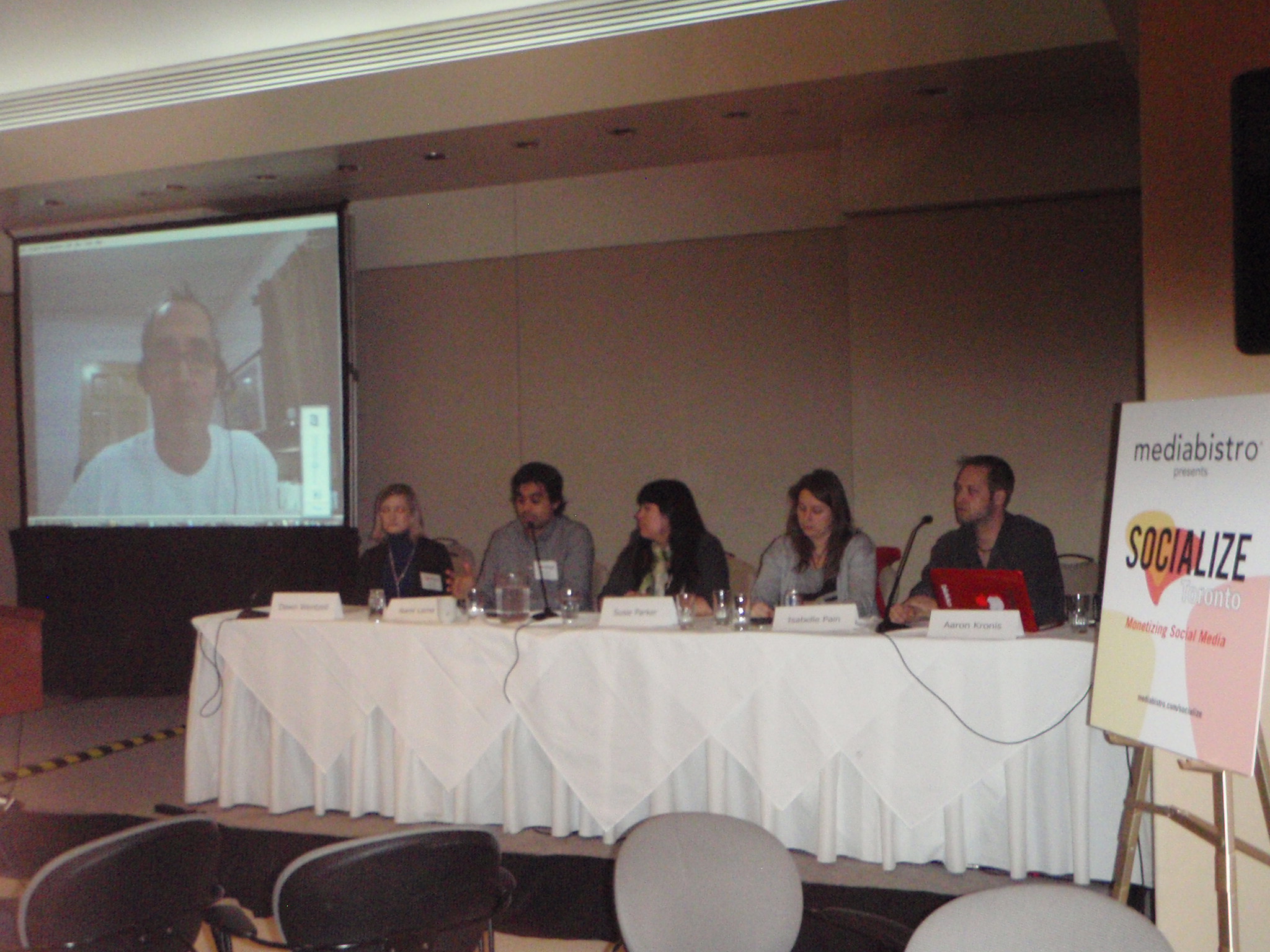
Panellists on Mobile, Social & Local: Moderation by Skpe
IP: we are restricted to native apps. We track 40-50 million active users a month. Regarding split b/w tablet (15-20%) and phone (75%) but tablets are gaining momentum b/c they don’t replace phones. Soon we are getting to a 30-70 split
Rami: Tablet is cannibalizing desktop, laptop market now.
AK: Apps like foursquare, do you see a societal backlash?
Eric: it’s all about education and know how to turn off and on your privacy settings.
DW: Onus is on the user as to what data they are willing to share.
Eric: it affects experience if you turn off where you are
SP: Please don’t check into your house. We already know your the mayor. You need to do due diligence like don’t geo-tag your pictures with your kids, check your credit report and run your kids name through google, etc.
AK: As a parent set a google alert on your child’s name
SP: Don’t check into your kids school.
Rami: We all have to decide how much to engage in social. My fear is how much I give to the grid.
Eric: if you check in outside of your city then people know your not home so be cautious who you friend on foursquare
Question: do you read license agreements?
Most people don’t in audience.
Question: How do I monetize a plant based eating platform
DW: make everything shareable
TODD: change your profile pic into a qr code. Get beyond traditional SoMe platforms. Get on boardreader.com.
SP: Follow vegan hashtags and communities and Twitter chats on food since the community is already there.
Eric: Optimize your video on youtube since people love visuals
18.28
Measuring Social Media Success
Social Media is now at the forefront of online marketing efforts for many organizations. Unlike the early days of the web when measurement was a second thought, C-level management now wants to know the ROI/benefits of their social media efforts and the currently available measurement metrics are elusive at best. Attempts have been made to measure success by number of Twitter followers or Facebook group members but these are meaningless numbers. To meet the growing need for meaningful measurements several tools have come to market promising to help organization unravel this mystery. This session will explore what measurements organizations of all types should be focusing on and how the different free and paid tools can help them understand the positive impact their social media efforts are having on their campaigns and the organization itself.
PANEL:
MICHAEL O’CONNOR CLARKE Vice President, Digital Media, Media Profile
ALAN K’NECHT Founding Partner, Digital Always Media (moderator)
SEAN MOFFITT Managing Director/Author/Chief Architect, Wiki Brands
JACQUES WARREN CEO, WAO Marketing
MARTY WEINTRAUB President, aimClear
RICHARD ZWICKY Serial Entrepreneur
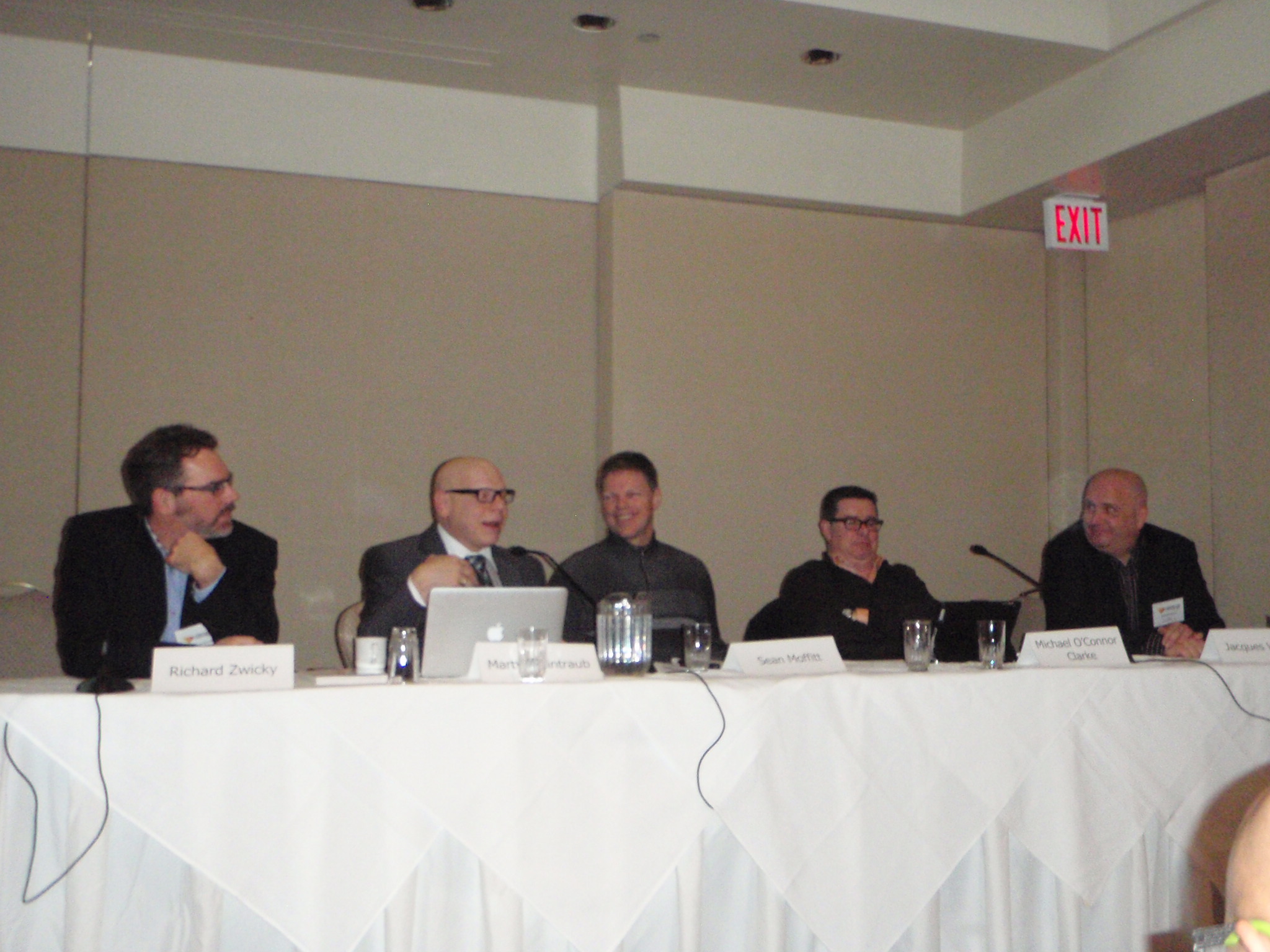
Panellists: Measuring Social Media
AK: What should a company do before creating a SoMe analytics soln?
JW: First they need to know why they are online and know what their goals are and decide how to measure it. Usually, they just use whatever is out there to measure already.
RZ: C-suite don’t know what they want to pull out. Once they’ve been at it awhile they become more intelligent. Don’t develop good kpi’s at the beginning but later on since they feel like they just need to be there because their competition is there.
AK: How many analytic solutions do you have to implement in order to get hat you want/need?
SM: you have to roll your own b/c it depends on your industry and no tool has exactly what you need
MOC: What are your objectives, what are you trying to achieve. Don’t look at outputs like likes but custom landing pages can be an outcome.
RZ: it’s great to use multiple tools but you have to consistently use the tools b/c you can’t compare the metrics from different tools
QUESTION: How do you measure your employees engagement in driving that profit?
MW: ultimately SoMe that transcends immediate circle has to have relevancy to the larger world. You have to ask yourself if this matters to anyone else other than your immediate circle. Inside marketing stakeholders are a good place to begin but has to go out from there to the world at large.
AK: what are your fav tools
MOC: Sysomos. While Radian 6 presents better and looks better but Sysomos finds better stuff. Number 2 is peek analytics which is in beta and out of the UK.
SM: Baseline is google analytics. Big fan of Sysomos b/c it can parse out if comments are from Canada. Like twitalyzer, klout, Edelman’s tweetlevel
AK: products like Klout and twitalyzer are good when used properly which if for finding influencers.
SM: most companies monitor well but don’t spend enough time going through their analytics properly
MOC: Not enough organizations spend enough time looking at analytics. Vast majority of dashboards are to justify agency budgets. What needs to be done is the ANALYSIS so we know what we did that moves things forward and backwards.
JW: Coming from sociology background, it is hard to truly measure influence while these tools are counting actions like RTs. Not sure this is the most efficient way to measure influence. If you say something and no one shares it then nothing happens. It’s the people who share your content that has been hard to identify and whether the sharers get re-shared.
AK: You need to truly look at who this supposed influencer is b/c they may be bad mouthing you.
MOC: Context is key
QUESTION: Marty talked about the inside joke and taking it viral.
MW: There are no boring products just boring marketers.
MW: Use google this way: Mining Deep “Site:” Operator Search To Uncover Multilingual Social Threads http://bit.ly/tAkTrY
SM: Need to know why you are being asked to measure something as well. We look at metrics b/c I need to file a report, asked for analysis or you have to chase down stats b/c someone is resistant to the idea.
17.44
The Power of Twitter Chats
The social media race is on for engagement and influence. Businesses, marketers, and even reporters and news outlets are in search of savvy ways to cut through the ever increasing din of social media chatter. This roundtable session will explore the evolution of Twitter Chats and the opportunities they present. We will examine the benefits of participating in these relevant Twitter discussions and making connections within Twitter chat groups. We’ll also discuss how to organize and host such chats, and leverage them to increase your own levels of expertise and influence.
PANEL:
SAM FIORELLA Chief Strategy Sensei, Sensei Marketing
KEVIN MULLETT Director of Product Development, Cirrus ABS
MICHELLE STINSON ROSS Online Media Specialist, Superior Virtual Services
JIM HEDGER Creative Partner, Digital Always Media (moderator)
JUDI SAMUELS Director of Marketing, Fairmont Hotels & Resorts
JH:In audience 5-20% of business use twitter chats. Sam is this accurate?
SF: Sounds right but there are a number of ways to do twitter chats. Most business don’t understand the value behind twitter chats.
JH: What does Fairmont use twitter chats for
JS: I’ve only been at Fairmont 3 weeks. I’ll re-iterate what Sam said is that they are learning how to use twitter and also to push their own thought leadership out. From a brand standpoint we are thinking of using it to extend the brand exp. for people.
JH: You have created a primer link at bitly.com/w3Geno – why?
KM: I wanted to lessen the time the panel spent discussing the tools out there and list of chats available. One of the things we will talk about today is how to monetize that? You need to figure out what your participants want.
JH: Michelle you co-host a twitter chat. How long did it take social chat to gain traction and how long could it take a business to grow theirs?
MSR: We experienced phenomenal growth immediately. People immediately took to it and have a core group that comes to it weekly. For other business, it will be about the passion level. What is your topic and expertise and will it matter to a community.
Alan K’Necht – the audience cares about who the guests are and these thought leaders spread the word to their followers.
MSR: We are now able to reach out to well known thought leaders we don’t know and can cold tweet them b/c we’ve built momentum.
SF: His chat bizforum is about trending business topics, Sam realized it’s about the community and not him. He wants to put it into the hands of the audience. You don’t have to know everything b/c as a moderator you are a facilitator.
KM: you may have great guest but if you don’t make it about the community, it will fail. You need to feed the people coming to the chat and keep them coming back. Most successful chats are those that are curated/moderated well.
JH: Is there a formula to follow?
KM: . If you humanize your message, encourage conversation then it will work.
JH: What do you do with the impolite person who bother people?
SF: I created a blog post about these people by personality type not by their name. You should not drop your blogpost into the stream. Do not insult people if they know less than you.
JS: Social media participants don’t like the hard sell. There are ways to promote your thought leadership without doing the hard sell. Sometimes moderators just have to ignore people who keep self promoting plus community will self police as well.
MSR: the community will often police itself.
JH: How do you monetize a conversation?
SF: If you’re a brand than that is monetizable. You should decide if you want to build a community first.
JS: SoMe isn’t cheap b/c it takes man-time. But a chat can be an interesting way to create a social crm.
KM: From a business standpoint, setup a congruent brand across multiple channels. Don’t let a twitter chat end on twitter but setup a facebook page, create a blog post about the chat, etc. It’s a great opportunity for individuals to create a relationship with people during a chat and slipping in your knowledge.
MSR: it’s about the wealth of information that comes out of a chat. you can create all types of monetizeable content from a twitter chat.
SF: To monetize on a chat you don’t just have to start or moderate one, you can just participate in one. It’s okay if you’re an introvert b/c SoMe let’s you stand up without having to be in front of hundreds of people.
JH: A measure of success is acquiring new clients but what are other measure of success?
JS: You don’t need to host a twitter chat. Yes, we’re all marketers but we are also human beings who have our own passions and interests. It’s great to participate in a chat where you share that knowledge and passion. Even if you don’t feel knowledgeable enough over time answer the questions in your head and eventually, you can begin answering questions.
Question: There is a lot of noise so how do you make sure good content gets recognized.
MSR: It’s a big challenge to properly curate.
SF: Alan K’nect does a good job of curating good content with storify the day after his chat
Question: Is the strength of a chat in the regularity?
SF: the strength is in the regularity unless you have a lead-up to a one time chat like a conference otherwise it will be hard to get participants
Audience: ask participants to favourite the tweets they really like
KM: Hashtags are like the hits of twitter. If you use hashcaster then make sure you note it is POTENTIAL reach.
16.56
EdgeRank vs PageRank: Increasing Your Visibility on Facebook
Facebook’s changes from late September have marketers reeling. Brands that aren’t adopting methods to increase EdgeRank are getting shut out of the News Feed, while those that create engagement benefit from more sharing and e-commerce. It’s been said that likes are the new links– that the signals of friends are akin to links between web pages. We’ll demonstrate live a couple examples of how social influences search results and vice-versa. You’ll walk away with an actionable checklist that you can bring back to your webmaster and social team, plus ways to measure the impact of these changes.
PANEL:
BRIAN CARTER CEO, FanReach
SUNDEEP KAPUR Digital Evangelist, NCR
ANDJELIKA MARTIN Director of Web Marketing and Development, M Resort Spa Casino
VERONICA STECKER Media Manager, Gordmans
DENNIS YU CEO, BlitzLocal (moderator)
DY: Goes to Lane Bryant Facebook Page where he is an admin and types in “Click LIKE if you’re glad it’s the weekend” – Got 202 likes in 1 minute. Go to graph.facebook.com/name
DY: What drives this engagement
Audience: activate emotion, about being human
Question: What the ROI
DY: When people click like we know who they are. Lag b/w when they click like and purchase can be weeks but their friends will notice and increase ROI
VS: content drives engagement. They run sponsored stories showing “your friend as liked a brand.” Everything they track is at POS which is slightly slower due to lack of eCommerce platform. On avg. a facebook fan spends double and she can prove it.
AM: They use it to get exposure on Facebook. One thing they wrote about was their Lost & Found and that pushed them to website where they signed up for promotions and then you can send them offers specifically tailored to them depending on the story they responded to. The trackable ROI has doubled since they began using Facebook.
BC: Biggest problem I see is that people don’t know who their fans are.
DY: What happens to a small brand who has a small fan base but great content.
BC: get on facebook ads b/c when you get a like you get interest but they need to drive to a sale
DY question: Sundeep can you give me the NCR perspective on POS?
SK: Backyard building company that has 3k fans on Facebook and list of 1500 email names but they post interesting questions such as “why do cardinals kiss” so they are funneling people in. Brands need to intrigue the person in order to connect with their consumer. Also gave a PF Chang example of bad facebook usage.
DY question: What are key diff. b/w Facebook and Google
SK: Google it’s about connecting links b/w people.
AM: Facebook is about asking questions. Google is about answering questions.
VS: Facebook is 2 way conversation. Most popular is the polls.
BC: Google is about harvesting demands. Facebook is about who.
AM: Look at how people are talking and then use those words.
Question: What do you think that there is no dislike?
SK: it’s like range of likes. How do you move people from that like to something else?
AM: There are 2 dislike buttons. One is silence and 2nd is a negative comment. 2 other ways is report the post and dislike an ad.
DY: Facebook does report on unlike through their feedback api. SO if you are a blackhat seo person you would click like & unlike a lot.
SK: At NCR we used to post press releases on facebook. Instead they are going a short video on the press release now.
AM: Don’t hit like on your own posts!
BC: B2B can be boring on Facebook so you can try to make it interesting. Don’t do fan marketing just do ads.
Questions: Back to the dislike button. Could there be a range of likes to make things easier for kids with shorter attention spans.
AM: If you hit dislike, I don’t know why you dislike the post.
Answer from audience: Customers will make sure you know they don’t like you since they will make a ‘I hate X group”
SK: Look at facebook as a dashboard of sorts and track & store in a CRM.
Question: Facebook and political campaigns. Do you have ideas?
SK: Politicians need to learn and accept how to use the SoMe tools. Don’t erase the negative comments and make sure you cover all your segments.
DY: it gets interesting once you mine them for the info they make public on a tool like blitzmetrics. So you get an idea of who they are and then create content they would be into.
DY: we don’t want to leave any comment unliked or uncommented b/c facebook will penalize your page for that
DY: your SoMe staff needs to respond immediately to every comment on social
15.47
Google+: New Insights on Using Google+ to Rank Better
It’s no secret that Google is giving extra weight in the search algos to their own social network– whether you implement the +1 button, join Google+, hit +1 in search results, or have a large set of friends in circles. Hear from brands and direct marketers who have experimented with these techniques to see which strategies fail versus generate the most traffic and conversion. Learn about unexpected findings, such as why timing is so important, how the +1 results increase organic CTR, and the impact of likes, follows, and +1’s together on conversion. Walk away with techniques you can apply to increase your G+ friend base and techniques to measure incremental improvement in Google via the new G+ API.
PANEL:
DANNY BROWN, Director of Retention and Social Media, Jugnoo, Inc.
LAWRENCE MAK, Product Marketing Manager, Social, Adobe
CHASE MCMICHAEL, President & CEO InfiniGraph, Inc
DENNIS YU, CEO, BlitzLocal
JIM HEDGER, Creative Partner, Digital Always Media (moderator)
JH: Instead of presentations doing more of a question session. What exactly is Google doing with G+
CM: G+ gives brands an opportunity to manipulate SEO further b/c search has become challenging with SEO companies playing the game.
DY: It’s too early. Have a presence and run analytics
LM: It isn’t a social network but a social layer
DB: G+ is a behavioural research platform and will give FB a run from both sides.
CM: Google is a formidable beast just see what they did with Android. If brands get in early and post they will score higher and get more visibility like Burberry
JH: When it came out people saw a FB clone but is Google a greater threat to FB or twitter or either?
CM: twitter has a dominance with broadcast media whereas majority of brands have a presence in FB and are using it as a website. But Google is creating a different class since many influencers have migrated over to G+. Social is transforming into something new.
DY: G+ is neither. This is a way for google to shore up their search dominance since CTR’s are down. Higher CTR gives you a higher CPM.
LM: Don’t think of it as a social network but more to shore up your rank. If you think about what you do on google products, you are searching or consuming timely information. This is what G+ will do by adding a social layer to search.
DB: Nothing is a platform killer. They are diff. eco-systems and G+ has yet to find what it wants to be. There is a place for everything.
QUESTION: In a post-myspace age, what can SoMe sites need to do from becoming Myspace?
CM: they need to innovate constantly so they don’t become irrelevant. Pinterest has taken it to the next level in that we are using a picture to communicate. You need to be relevant to your consumers.
DB: It was Rupert Murdoch that killed Myspace not Facebook.
QUESTION: Can you expand your comments on integration of Google plus products further Lawrence?
LM: Think of G+ as a social layer and the circles let’s you target. The potential to post links and drive consumers to your other places in the google realm is seamless. Your entire video library is on Youtube which links up to G+.
CM: Is Youtube replaceable and indispensable?
Answer from audience: Yes and no b/c there will always be niche places like vimeo. There is a tab in G+ that pulls in your youtube stream.
Question: Who owns the content you push out?
LM: As a brand you need to make sure that the content you are putting out there is your own.
CM: Copyright in social is problematic. Creative commons has yet to truly take off.
DB: It’s reasonably straight forward. If it’s a third party platform, it’s not yours. Backlink to the original source if you post something that’s not yours.
QUestion Mod: Are people using G+ like FB?
LM: it’s still too new. Sony is taking some of their FB best practices and seeing what sticks on G+.
DB: The amount of G+ users may not hold up since Google automatically creates a G+ account when you create a gmail account.
LM: Have to think about who is on the platform in order to decide what to post, etc.
Question: Youth lead Social Networks and are you seeing youth active on G+?
DB: Good point about demographics and this is every networks challenge. This is changing now b/c brands are really driving social networks now.
LM: We measure success if they reach a mass of users but I’m not sure that is the case with G+ since it’s more about search. We’ll see brands jump up on G+ because they want to turn up higher on search.
DY: There is only single digit adoptions on G+. It has yet to become a social network but will shore up your CTR. People will be where other people be. Right now there is no way to use +1’s so if you don’t get them, your search results will suffer.
QUESTION: what about schema.org
CM: who knows what G+ will be in 6 months
DB: look at Pinterest and demographics are women up to 45 yrs who are moms. If you’re a smart business and these women are your demographic now you have an exact place to target them based on their time of upload and activities.
Question: Will G+ work with adsense?
CM: NO. Google has already been gamed to the hilt by affiliates.
Question: What can we expect in the future, is there any room for Google to add more to G+
CM: have you seen Chatr and Salesforce.com
LM: Seeing G+ as social layer for other google products is important. There are unique G+ tools like hangouts which could be brought into any organization for collaboration.
Question: for the 1 person operation with limited and resources then how do you get started
LM: drive follower growth with +1 button and then create content for G+ and see what works best. All metrics G+ is providing is around engagement. Get in their and experiment, get followers and then drive enagagement.
DY: if you’re thinking about where to allocate your time then see through analytics where your traffic comes and concentrate on that as long as you have a base layer everywhere.
14.02
Facebook Advertising for Results and ROI
Facebook advertising is a huge opportunity because of its unique targeting abilities and relatively low costs. But cost per click and cost per fan can vary from $CONTENT.01 to .00. What tactics get you the right fans and website visitors at the lowest costs? This session will expose the ins and outs of Facebook ad targeting options, image selection, and copywriting to get you the best fans for your business at the lowest possible cost.
Panel:
HUSSEIN FAZAL CEO & Co-Founder, AdParlor
SETH LIEBERMAN CEO, Pangea Media
NIKHIL SETHI Co-Founder and CEO, Adaptly
VERONICA STECKER Media Manager, Gordmans
MARIO ZELAYA Managing Director, Majestic Media
BRIAN CARTER CEO, FanReach (moderator)
BC: in his opinion FB ads are the biggest opportunity right now with great reach
Mod QUestion: What makes FB adds profitable
Answer: make sure you know where your ROI goes. Clearly define your goals and track conversions. Know what that conversion is worth to you.
Answer VS: Matters who and why you are tracking them. Sponsored story ads give you a higher click through rate. get good engagement through Friends of Fans and sponsored stories.
ANSWER: ROI doesn’t stop at the Like but once you achieve that you really need a plan to drive that person to your ultimate goal and follow through.
MZ: Determining ROI can be quite complex b/c you need to define your high level metrics first.
QUESTION: ROI can have many definitions. It depends on who your brand is and what you want to achieve.
Mod: the more affordable your fans are. the more engaged they are the higher the ROI
QUESTION: Since you are a real world retailer, how has Facebook affected your ecommerce channel?
VS: Don’t have ecommerce yet but we do a bit of couponing but not so much to the detriment of the retailer. We’re currently building our ecommerce channel.
SL: Technology is enabling us to run ads in multi-channel environments in order to do customer acquisition. It’s still far from perfect but much easier from 18 months ago.
MOD: If you don’t have a huge budget then you don’t really have a big budget for analytics.
QUESTION: Biggest mistake you have seen people make with facebook ads
VS: extreme couponing
MZ: misleading ads
answer: companies try to take what works on search and use it on facebook but it doesn’t work. You need to start with the shallow goal first aka FB fans and then move to deeper conversion.
SL: You need a plan. It’s about what you do with “likes” that matters. Re-inforcing the Facebook brand on your landing page is very useful.
Answer: People forget to think about mindset when approaching an ad. Social it’s about demand generation. The moment you take someone out of facebook, it changes their mindset.
VS: We want each of our stores to have their own FB page but we don’t want to comment back on each comment. THIS does not work.
MZ: Brands forget that they can target to their particular demographic.
SL: I expect people/brands to respond back to me. Ex. I’m a runner and asked Brooks if I could use pair x of shoes for a long run. They responded back in an hour and said use shoes y. So SL asked for a coupon to buy shoes y which brooks gave him.
QUESTION: what is a good baseline for reach and frequency in Facebook ads
MZ: that’s a hard question to answer b/c it depends on when you are doing it and who you are targetting. The higher target demographic you have, the lower the reach you will get.
SL: use re-targeting
Answer: Facebook provides reach and frequency for ads and campaign but not on the account level. They focus on CPA metric.
Mod Question: Do you combine Facebook ads with other channels and tactics and how does that work for you?
VS: On our TV commercials we have go to our FB. We have direct mail w/ QR codes. All our ads will drive consumers to FB and Brand pages but still trying to figure out what the consumer saw and define who this person is, what’s more effective in order to optimize.
MZ: All your ads need to be integrated into the larger campaign. Facebook is only one channel of many.
SL: A lot of people don’t have big budgets though but you can be successful using online self-serve services.
VS: Whatever channels your in make sure they are integrated
Question: Intellectual Property rights on Facebook ads? Obviously people use images that aren’t theirs?
Answer: Not sure. Facebook isn’t being diligent about this but if an owner reports then Facebook will help you get it down.
13.18
Facebook Marketing: Legal & Regulatory Compliance with DAVID M ADLER Partner, Leavens, Strand, Glover & Adler, LLC and FAZILA NURANI is the President and Founder of PrivaTech Consulting
The use of social media for marketing and advertising purposes is one of the fastest growing areas for business and marketers. The advent of social media sites like Facebook provides the opportunity for authentic interaction and engagement with customers. Therefore, it is no surprise that it is being used as a marketing tool by companies large and small to help them achieve their strategic goals. But with every technological development and opportunity, new legal and business risks present themselves. Understanding and minimizing these risks will help you maximize the opportunities. A best practices approach to social media marketing involves having the company’s philosophy, methodology, and guidelines captured in a comprehensive written policy that is clearly and regularly communicated to the employees, and regularly updated to keep abreast of new developments, opportunities and evolving legal guidance. Attendees will learn how to identify the legal issues and develop policies and procedures to keep informed about the current technology, marketing strategies and regulatory compliance.
They will be focusing on privacy issue and then will answer questions about Facebook.
FN: Represents Canadian perspective but when it comes to the Net there are no borders so case law affects both sides of the border and vice versa. On Facebook only 15-20% of people change their privacy settings even though 17M Canadians and 150M Americans are on Facebook.
FN: Privacy laws apply to personal info collected, used & disclosed in the course of commercial activity. Privacy laws in Canada are a mix of Federal (PIPEDA) and Provincial laws.
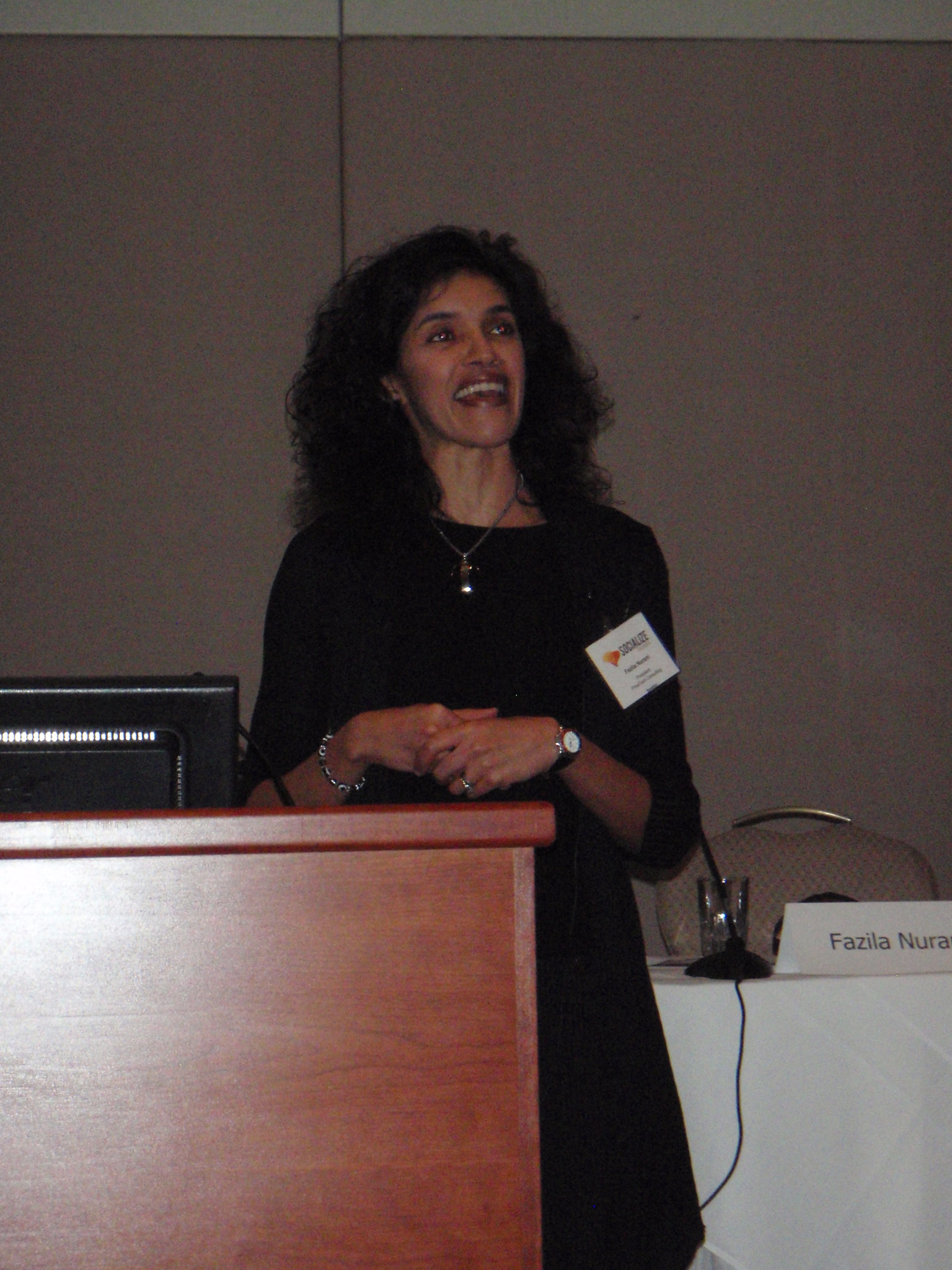
Fazila Nurani informs the attendees on Canadian Privacy Law
FN: In SoMe law we care about where the user is not where the servers are, etc. The Officer of the Privacy Commisioner of Canada investigated Facebook in August of 2009 and found that personal info was being shared with 3rd party developers; distinction b/w de-activation and deletion of account & lack of transparency in FB’s privacy policy. Commisioner gave them one year but still under investigation is the LIKE button and what info is shared about people who like through the api.
FN: The courts are still clearly struggling. There is a lot of blurring of the divide b/w public and private. The more friends/fans you have, the less the “expectation of privacy” is the reasoning we are seeing in the courts. The law is being stretched to fit SoMe as well as looking at international cases.
DA: The USA doesn’t have a comprehensive privacy framework but have a patchwork of various laws and state laws. Americans have the FTC (Federal Trade Commission) and has become busy recently. The public believes all content is free but from a marketing perspective, it’s not free and we expect data about them. We need to find a balance b/w what brands/marketers and consumers need.
DA: Recent key FTC actions/decision recently was that Twitter’s API was too easily hacked and Twitter had to take part of a compliance plan. Next was Facebook deceiving consumers about public availability of private info b/c FB was constantly changing their privacy policy without the users knowledge. FB settlement req’d bar on misrepresenting privacy & security; affirmative consent req’d for privacy overrides; 30 day access limit for deleted accounts; create & maintain a comprehensve privacy policy & submit themselves to 3rd party privacy policy audits.
FN: Canada has new guidelines for behavioural advertising and they are all focused on consent. There have been discussions that this may not always be practical. See guidelines at http://www.priv.gc.ca and what you need to do from a consent perspective.
FN: There is a class action lawsuit out of Manitoba against Facebook that will be the largest in Canada. FN assumes it will get settled but people can still enter the suit.
FN: The Fighting Internet and Wireless Spam Act (FISA) is about any commercial electronic message such as email, sms, comments on website, SoMe. It is an opt-in model unless you have a previous existing business relationship (transacted within the last 2 yrs).
FN: in SoMe context there are new defn for “family” and “personal” relationships which require at least one real-time interaction.
FN: Everyone should prepare now b/c it will be implemented rapidly.
FN: FISA is supposed to replace the Do Not Call List because a cem is also defined as a voice message.
Question: Likelihood of this being implemented will result in companies giving up email marketing?
FN: the fines are really heavy and gov’t is really prepping for this law and creating a centre for the public to report spam
Question: what about direct mail
FN: No, just electronic.
Back to David for trends in USA
DA: Has brought up the WSJ What they know series which has brought it into the public consciousness which has resulted in “Do Not Track” bill and “privacy bill of rights”.
DA: Federal right to privacy is really being discussed in the US. The FTC has become more active in protecting consumers. They have a blogger guideline that will apply to Canadian bloggers if they target a U.S. audience. We all have disclosure obligations that need to be made when talking about brands, our companies, etc. and this will become more important in the near future.
DA:There are many cases in the courts right now. DA is currently closely watching Phonedog case where an employee took his twitter followers when he left the company. Who owns a companies twitter followers isn’t clear yet. Bigger issue is if you are an agency who manages a brands twitter account, who owns the followers.
DA: There are industry initiatives coming online about when, where and how much needs to be disclosed. From a SoMe advertiser perspective, develop a SoMe policy that needs to include what employees can and can’t do as well as reviewing privacy policy, use & protection of data policy regularly.
QUESTION: Question of FISA. What if a Canadian sets up an office overseas are they subject to the law?
FN: Yes, if they target a Canadian.
QUESTION: American Red Bull case where person got fired.
DA: there have been many cases like this and FRB has sided with employees in most cases.
FN: In Canada, SoMe firings are being seen as rightful terminations by the courts.
12.31
Creatively Social: Breaking Out of the Ordinary by RIC DRAGON, CEO and Co-Founder, DragonSearch
While the best social media marketing campaigns are built on sound marketing process, the time will come when you need to break out of the ordinary, and do something astounding. This session addresses approaches that individuals or teams can take to come up with brilliant ideas, by following a path from audience sub-segments, communities, and influencers – to various creative ideas for breaking out of everyday thinking. The session will also address how to maximize ongoing value from the great creative campaigns after they’ve ended, capitalizing on the new connections made.
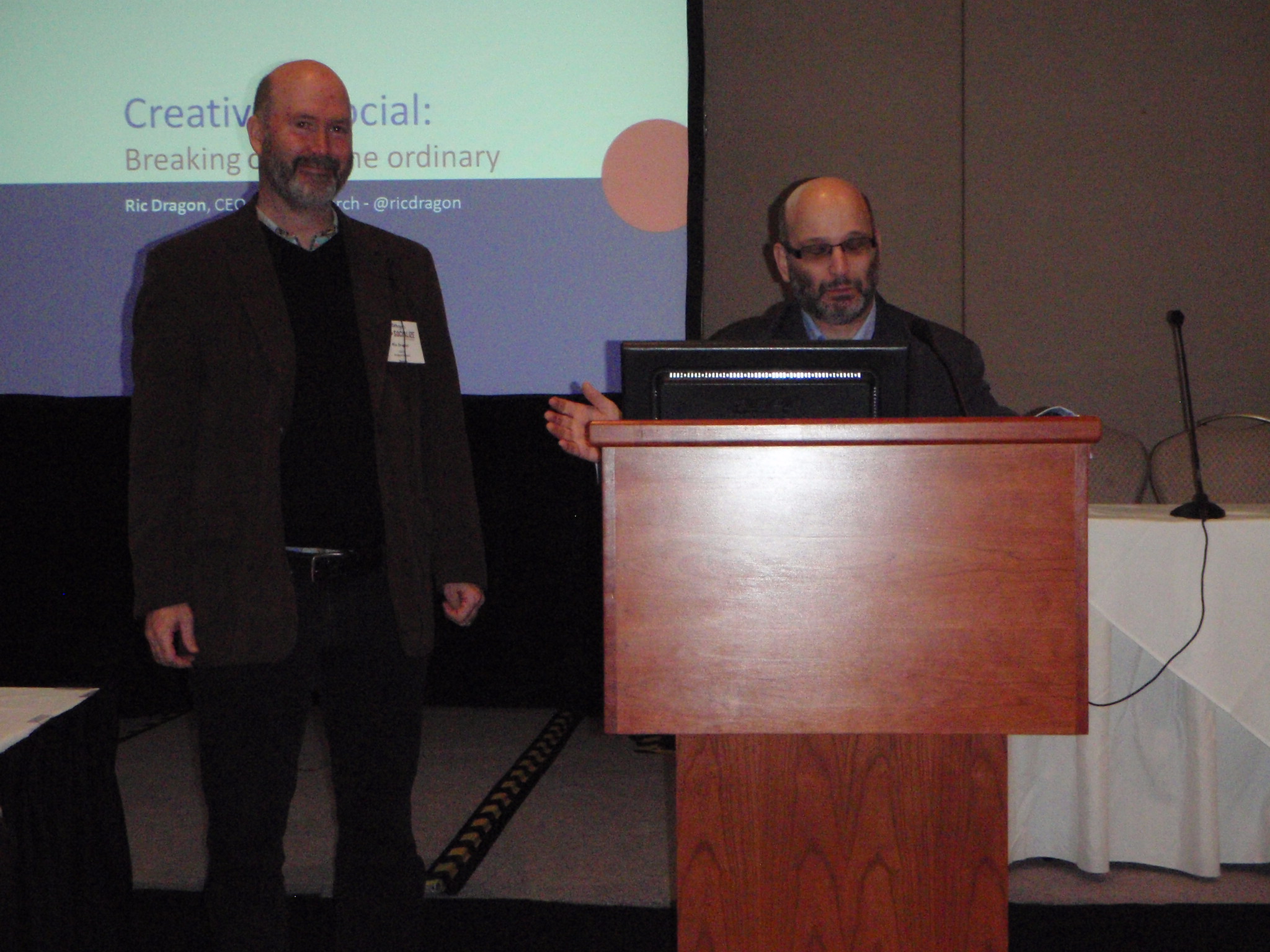
Alan K'necht introduces Ric Dragon: Creatively Social: Breaking Out of the Ordinary
Theme today is creativity in social media. Frst premise is that not all SoMe projects are equal.
1st is brand maintenance – monitor brand, responding to people, creating accounts.
2nd is reputation mgmt & my engagement with SoMe
3rd is community building – trying to develop own leadership in my community or even building a community
4th is Influencing individuals and trying to engage influencers.
5th is Creative Projects like the Old Spice Guy that make a big splash. One of the things that Weiden Kennedy did was research that showed women & wives do the buying of these men’s products. They began on 4chan which was very risky.
An other example was the Hoodie Remix campaign for Champion where people could make their own design.
An other example is the Pepsi Refresh campaign. First engagement was submitting names, 2nd was voting for winner.
ex. Saatchi & Saatchi Dynamite campaign where the explosion allows a surfer to surf.
What do the above have in common? Big budgets, great media buys but not all are like this for example Blendtec which had no big budget or media spend.
Most of these campaigns have FUN.
They also have the UNEXPECTED which is what gives us a jolt of dopamine and addictive.
Also PARTICIPATORY – they engage people to participate. Being involved gives people buy in.
CROSS-MEDIA/TRANSMEDIA – example is Uniglo and they just opened a NYC store and their campaign told stories of real New Yorkers b/c Uniglo donated money to these people’s causes and linked to their participants SoMe.
Into transmedia then you’ll want to reference to Henry Jenkins and his writings & research.
Transmedia is spreadable instead of drillability, has continuity, immersion, worldbuilding, seriality, subjectivity and immersive.
Look up liquid and link and it’s a great example of transmedia which was a presentation Coke gave at Cannes in Youtube.
In Coke’s presentation they talk about serial, multi-faceted storytelling and engagement with immersivility.
In Rick’s company, they use concept of SCRUM which they borrowed from coding.
Alex Osborne was O of BBDO and he invented brain-storming. Ground rules is that any idea goes but in reality this often doesn’t happen because more powerful speakers will take over so perhaps write down the ideas to avoid this.
Genrich Altshuller looked at tens of thousands of successful patents and he realized there were certain patterns of problems and solutions. He developed a system called TRIZ. This system can be applied to marketing.
An action plan through execution, measuring & reinvention leads to desired outcomes. Depending on your org you can then enter a loop that talks about us and them. The Social Media marketing Process “Loop” consists of US/Them/Communities/Influencers. In SoMe we need to have a clear idea of who is US which becomes critical when you have multiple voices out that have their own individual voice while maintaining the brands voice.
Them is them but we have to identify the community and then micro-segment them so you can identify the influencers and work with them.
Unruly Media chart that identifies if a video can go viral with 12 categories.
Creative thinking represents the greatest opportunity to create value but often we are to busy doing brand maintenance instead of building community.
QUESTION: Can you apply these concepts to smaller orgs?
RICK: Look at the Blendtec campaign. Blendtec is a blender targeted to bars b/c it can crush anything and people loved it and started to buy them for their homes. Unexpectedness/Novelty is critical b/c audience will be bored since they already saw it. You need to identify your micro-audience and their influencers so you can study and understand how they and their communities think. Very creative campaigns don’t necessary require huge budgets.
QUESTION: What are the odds of a campaign going viral.
RICK: You can’t make a viral videos but we can hit on Unruly’s different categories but first you need to research your audience and understand what tickles them. Like in tech, you need to find the early adapters first.
QUESTION: Thoughts on using SoMe for B2B, B2C, etc.
RICK: I have yet to find an audience that it doesn’t work for. Ex. of a client that has an anti-biotic for chicks and client wanted to reach 5 people which the campaign did.
RICK: Dark side of creative campaigns is that we do them and then forget about them. We need to build upon them and create more value in the community.
11.26
QUESTION: How can you monitor someone if you don’t know if they read your blog before you transact with them.
SAM: Someone could be reading your blog and call you out of the blue unless you ask them during the call if they’ve engaged with you before. You’ll never get it at 100% but you will get some.
QUESTION: What company that does this well in Canada.
SAM: Best Buy has been able to measure that 1% of engagement that they can track leads to 100K of gross revenue
QUESTION: Our clients are trying to get us to change their ecosystem b/c their Boomers don’t work well with younger employees.
SAM: We go in and create the ecosystem but the client has to do it internally.
11.15
Establishing A Corporate Social Infrastructure: How to Leverage the Social Media Channel & Drive Measurable Results by SAM FIORELLA, Chief Strategy Sensei, Sensei Marketing
It’s no secret that C-Suite execs in most large businesses have been slow to acknowledge the social economy or to formalize and fund social engagements across their organizations. But the communication tidal wave that is social media cannot be stopped and many business silos have begun their own individual efforts given the lack of executive leadership in this area. Be it Customer Service Managers scouring Twitter feeds, HR teams monitoring LinkedIn, Marketers advertising in social networks or PR Professionals engaging social influencers, most enterprises are engaged in social relationships through disjointed efforts initiated by the customer or customer-facing departments. Therein lies the challenge for enterprise leaders; and the opportunity if they accept this call to action. How does the enterprise adapt to the internal communications changes that are pushing it to be more open? More social? The employee’s adoption of social communication does not translate well to the kind of work groups that are formed in most businesses. So the inevitable introduction of social networking-style communication into an office culture will have powerful implications on how businesses are structured and managed. But you need to understand how to enable it without losing control of your business’ corporate vision. Using real examples from the corporate world, you’ll walk away from this session with a blue print to creating your own cross-silo social communication effort.
Focus of Sam’s business is building corporations customer base but also the value of the customers.
With rise of social media, clients began asking what the ROI of Social Media is.
What is the reason businesses can’t measure ROI of social media? Don’t define goals, not a real conversation, not integrated w/ business goals, don’t carry it through life-cycle of customer relationship.
Corporations fail to show SoMe ROI because they fail to align dept’s SoMe strategies to their larger strategy.
Businesses goal is to make money and profit is not a 4 letter word. The social media goals of Sam’s clients went in all directions and didn’t meet the larger companies goals.
WE need to get SoMe goals to lineup with businesses goals.
Companies need an effective social media path and align all the depts to the same goal and same end of the corporations goals which is profit.
SoMe goal of C-suite is subject matter expertise. HR is acquisition of talent. PR is reputation mgmt. Marketing is lead generation & nurturing. Sales is revenue generation and Customer Service is retention. Sam suggests these are metrics and not goals since the goal is to make money.
Metrics are the logical and emotional connection that a business has with its people. SoMe metrics don’t equal business ROI. Profit = ROI
Social Media is not marketing. Internally companies need to be communicating properly before having conversation outside with customers.
CUSTOMER SERVICE METRICS:
# of customer complaints found and # of customer complaints resolved
How do the above metrics get you to profit?
Now need to build model that observes the entire lifecycle, eg. was the complaint rectified?
Have you understood and analyzed why a customer might not buy again and reporting into company in order to take action.
If customer is happy, have you kept engaging them? Did that customer keep buying?
This is the type of model you should have for any type of engagement not just SoMe.
Customer Lifecycle is awareness, interest & desire if these work well then you get a purchase but then you need to ensure that you are getting their support, loyalty and if they become a brand advocate. All of this needs to be measured throughout the lifecycle and see how one feeds into the next and finally see the impact on the bottom line.
If you want metrics then you need to figure out how everything you do makes money. All depts should map out how they make money for the business.
How do we build a corporate social media infrastructure?
Do we have a message to share? If you don’t then the customers will do it for you whether you like it or not.
In absence of a consolidated social media plan across all depts, individual managers will execute for their depts individually but are they responding with the appropriate communication strategy that can be measured.
Social engagement is not a tactical execution but a cross-function business strategy. It’s not just the outbound marketing but how are you communicating internally, aka a social enterprise.
Sam’s company has created a model called the PROS team, Process Resources Oversight Support.
Social enterprise requires more than a voice, it needs a new microphone.
There is a generation gap building in your organization b/w Boomers who are Managers and Gen X/Y who are staff. The gap is not only in how they speak but also how they work. Boomers don’t understand power of what SoMe can do for their business. The HR dept needs to step up and train their people. The classic hierarchical structures need to be broken down and go to a matrix structure.
What is Social Business: Company needs to bring in customers into the org but need to provide autonomy to depts. All the depts need to be involved in the conversation in order to solve problems.
Employees need to be able to have easy access to resources in order to meet client needs. Solutions should come to the employees.
Social Risk mitigation should be proactive not reactive. You’ll scare your employees when you give them SoMe policing policies and your greatest brand ambassadors will be scared to champion your company.
Community Managers are a must have and they need to be able to speak about all the lines of business.
Social Training is necessary for all employees not just C-suite.
KEY is focus on profit if you are truly going to measure the effectiveness of your campaigns.
10.36
Opening Keynote: Past, Present and Future: Measuring Social Media’s Impact by ALAN K’NECHT, Founding Partner, Digital Always Media
As media, small businesses and corporations embrace social media, the evolution and revolutionary natures of social media are often overlooked. Social media has been a factor in human communications for a long time though the Internet has enabled extraordinary growth in technology, accessibility, interaction and personal involvement. By failing to recognize social media’s longevity and the rapid pace of change in communications technologies, modern social media adopters are implementing measurement methodologies that simply don’t provide accurate or meaningful measurements. By exploring the true origins of social media and how the lessons of the past can be applied both today and in the future, businesses world-wide can ensure both successful social media engagements and establish appropriate tools & methodologies to measure social media success.
Purpose of keynote is to ensure all attendees are on the same footing.
Definitions:
Social is an informal social gathering
Media is a medium if cultivation, conveyance or expression.
What is social media?
A variety of medium used to draw together people with a common goal or objective – A. K’necht
Our first social medium was crying and is easy to measure since baby’s cry for a few different reasons.
When we talk about measuring social mediums, we are really talking about social marketing and social marketing campaigns.
Social Marketing is a fire since its goal is to draw people together. Is this any different than what we do today?
What we do at a campfire is exchange information with each other which is what we do on social media.
Gutenberg’s Printing Press enabled people to write books and exchange ideas with each other as well as giving rise to literacy. The press became a catalyst for the French revolution b/c it allowed people to gather and exchange information for a common goal. This is no different from what happened during the Arab spring one year ago.
The tools have changed over time but the commonality is the WORD.
Example of old town store that became a social medium where people would hang out, exchange ideas and could get tips, etc.
Nothing has changed, just the tools that we use.
Example of his 9 yr old son and his friends always utilizing their iPods in order to exchange info and play games with his friends in real-time as well as online with people all over the world.
In the 80s Madison Ave. understood this and put it in a commercial, the problem was that they couldn’t measure it. Video of a Heather Locklear soap ad and Mad Ave. used the power of the multiplier in order to get WOM out.
The multiplier effect is incredible because the spreading now happens at enormous speed.
We need to measure the right stuff but many people are measuring the wrong stuff like having the largest fire aka followers.
We need kindling & fuel, oxygen and spark/heat for a successful fire.
Fuel/kindling is followers, fans, contacts, head count – on their own these numbers are meaningless. Simply measuring head count on it’s own isn’t important. Sure you can use tools to see if the followers are quality or not but still not enough.
Oxygen is your content, does it motivate people and does the message help generate reaction.
HEAT is the content being passed on/acted on and we can MEASURE likes/shares, comments, retweets, g+, etc.
But we need the right balance b/w all these elements or you could end up with an uncontrollable fire.
Example of SOPA/PIPPA protest where congress wasn’t prepared to react to general public and protest by big companies.
Overall success relates to volume and quality changes in audience, amt of content published and shares & actions. The impact is the success that will ultimately improve your bottom line but won’t be overnight. For example Old Spice had to wait for people’s shampoo to run out before sales went up.