The Title Tag Element

Title – Importance: Infinite – Unique to each page
There are four basic areas SEOs are concerned about when looking at your website. The first and most critical of the four is the Title Tag.
The title tag is the first piece of information, aside from the URL of the website, a search engine receives when it examines a page. It is also the first thing a search engine user will see as it is frequently used to form the text of the reference link from the search engine to the page.
In source code, the page title is placed in the <head> section which is generally found at the start of the code. It would be expresses something like this,<title>The Title Tag :: Search Engine and Social Marketing :: Digital Always Media</title>
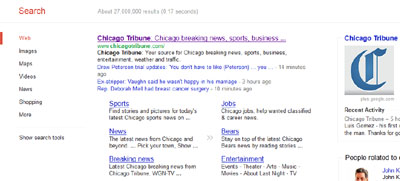
Google and Bing both expect webmasters to use page titles to inform search engine users and page visitors about the content found on the page. The Chicago Tribune provides excellent examples of how to structure page-titles for two primary readers, live visitors and search engine spiders.
The page title of the home (index) page of the Chicago Tribune reads:
<title>Chicago Tribune: Chicago breaking news, sports, business, entertainment, weather and traffic – chicagotribune.com</title>
Please note how the Trib’s SEO guidelines place some keywords in front of others while excluding mention of entire sections of daily content coverage due to the relative number of times search users enter specific words into search engines when seeking news information.
Every page in the website has target keyword focuses which tend to move from general to specific the further into a website one goes. For instance, the INDEX or HOME page requires a fairly general spread of keyword targets as that page represents the entire website. A second level page (About, Contact Us, Sports, News, etc…) would have a slightly more descriptive page title tag as those pages direct traffic towards third level pages which contain information or articles that address very specific topics, ideas, events, or items. The third level and blog pages would thus have the most topically specific page-titles.
Keyword targets should be added to title tags in order of importance. There are two factors to consider when determining the importance of a keyword. The first is topical relevance; the second is frequency of usage by search engine users.
Topical relevance can be determined by the author or webmaster fairly easily for third and fourth level pages. A blog post about “Blue Widgets” is a blog post about a (fictional) object that requires little effort to define. The keywords used in the title of that page should be relevant to the subject, “Blue Widgets”.
For higher level pages, topical relevance can be a little more difficult to determine. In order to describe a website that represents several topics that might switch from week to week or month to month, we try to be as general as possible in describing content that is likely to remain constant over long periods of time. Our selection method here would be to choose the most frequently searched individual descriptive words and work to make keyword phrase combinations out of them, or, failing that, place those individual keywords close to each other in the title tag.
Effective use of page titles can make the difference between achieving strong rankings and languishing out of the Top10. They can also help search users differentiate between two sites carrying similar information. If your title is more descriptive or better worded than your competitors, your site is more likely to earn the search user’s click.
Aug 12
27
The Ever Changing Klout Score
If you’re active in Social Media and interested in measuring your performance using a variety of social applications, then you’ve no doubt looked up your Klout Score. Klout and similar tools attempt to measure and quantify how effective individuals are using all the different social tools. By applying these various interactions across various applications to an algorithm, these scoring tools derive a score that purports to be some kind of measure of influence in the social media world.
Klout being one of the highest profile social scoring tools has marketed itself as, “The Standard of Influence”. With this marketing position, Klout has come under fire over the past couple of years as people start comparing their scores to friends, co-workers, industry peers and celebrities. Little insight has ever been given on how Klout’s algorithm works and why for more than an year Justin Bieber scored a perfect 100 while the President Obama scored significantly lower. Was Bieber truly more influential that the President of the United States? Of course not, but Bieber and his staff (under his moniker) were more active at Tweeting, Facebook updates and other social interactions to which his fans, would retweet, like, share, G+ and more. All of which contributed to his perfect score. As popular as President Obama might be, his fans rarely faint at mere mention of his name, much less reTweet everything he posts.
Two weeks ago in an attempt to address this issues plus the ever changing landscape of social applications (combined create the on-line social networking sphere known as Social Media), Klout once again revamped its algorithm. And just like when Google changes their algorithm, people got bent out of shape and stopped paying attention to the improved results, unless of course they’re the beneficiary of the change.
What changed in Klout this time is a significant increase in measurement points in the the algorithm from a few dozen to several hundred. The result of this change has, for the most part, been stabilized scores. It’s much harder now to get a major change in score over night (up or down). One thing Klout has always done when ever they updated their algorithm is work the number backwards so you can see the overall impact.
Take my score for example.
Prior to the change

After the change
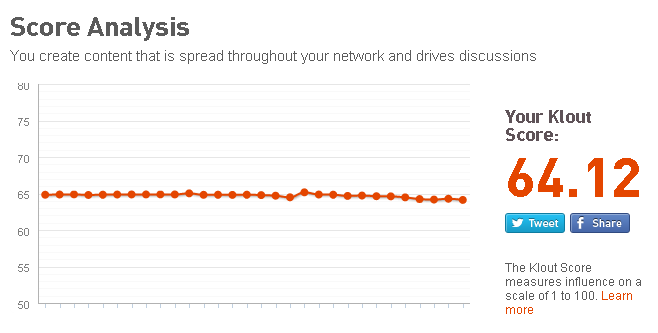
Now the big question… Yes, President Obama now has a higher Klout score than Justin Bebier. The next big questions are, “What did Klout do and and how can I leverage this changes to get a higher Klout score?”
To answer the question about how you can manipulate the score to your advantage I have to counter with, why do you care? The score is ultimately a measure how effectively you personally are using various social applications. If you manipulate the score, the number to you becomes meaningless and you’ll have spent more time doing things to manipulate your Klout score then actually using social media applications for what they were indented for (your benefit).
But to give you an idea of some of the changes that have taken place, here are a few that were revealed to members of the Klout Squad, (an unpaid advisory group that I am a member of), just before the release of the new algorithm:
- A look at the make-up your contacts on LinkedIn including their titles and how many recommendations they have received
- How many +K you’ve received and who gave them (their Klout score)
- Do you have a Wikipedia page, if so how often is it update and what category is it in
- Likes of LinkedIn posts
This goes hand-in-hand with some of the previous key measurement points of:
- Total number of Facebook status update likes and shares
- Total number of Twitter reTweets, and by whom
- Number Foursquare comments that were liked, and by whom
- Number of Foursquare tips left that were liked or completed by others
These are just a few of the most high profile components of the Klout Algorithm. The weight each one gets along with all the other key measurement points is part of the secret algorithm. What is helpful is that Klout is also releasing a new interface which is making many of the above elements more transparent which I’ll cover in a future blog post.
What all this boils down to, is that Klout is evolving its scoring model as the world of social marketing evolves and not remaining static. Just as Google and Bing are constantly tweaking and occasionally releasing major updates to their algorithms. If you care about your Klout score, then treat Klout like a search engine and think long term benefit and not just a short term gain. By simply using the appropriate social tools for your specific needs and using them as effectively as possible, you’ll get the best possible score from Klout and more importantly you get the biggest bang possible using social media.
Aug 12
24
SEO WebConference 2012
Once again, I’m thrilled to be participating on behalf of Digital Always Media in the latest on-line conference series “SEO WebConference 2012”. This series of live 1 hour guest lectures has been taking place since August 3 and I’ll be speaking on Wednesday August 29th on “Web Analytics for SEO“.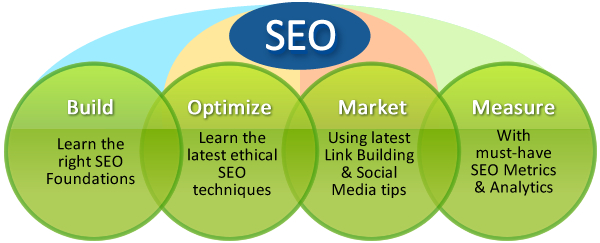
What I love about participating in this series is not just the ability to give back to the community, but the ability to participate in something I strongly believe will be come more common in the near future. Yes on-line conferences are and will be common part of everyone’s learning process.
The benefits of on-line conferences in this format are:
- No need to travel, saving countless hours of travel time and expense
- The ability to spread out the conference sessions over several weeks to minimize the impact of being out of the office for 2 or more days when attending external events
- Allows conference organizers to get high quality and hard to get speakers who can more easily schedule in 1 hour instead of giving up 1 -2 days (because of travel etc.) to speak for 1 hour
However, there is one major short coming to on-line conference. That is the networking that goes on before, between and after sessions. I’ve been to many conferences over the years where I learned more in a impromptu 15 minute breakfast conversation than I did by sitting through countless sessions. I’ve also mad life-long friends during the non-session times as well.
But the missing element of the conference networking is slowly working its way into the on-line world. I know during my on-line classes for the University of San Francisco’s Digital Analytics program, I set-up specific time for the students to get to know each other during the live classes and have heard from some of them that they did in fact form bounds with the other students. I’m sure components like this will slowly start working their way into on-line conferences as well.
The lesson here, don’t be afraid of on-line conferences or even on-line events. You can still learn a lot and save time and money on travel.
It’s no surprise I (heart) ‘the interwebs’. It’s my life’s work, my passion, and my fun. I’m not always keen about certain aspects of it, though: our complete lack of privacy and willingness to forfeit it are my most common complaints about social media. But I’m from a time before the internet: when you had to find information through the Dewey Decimal card catalogue instead of Google, something my teenage nephews have clearly never heard of, and sometimes my scepticism gets the better of me when I hear of yet another social platform. Medium may be the first one to change my mind.
Twitter co-founders Evan Williams and Biz Stone developed Medium out of an interest of developing a social sharing site the focuses on quality content while allowing an ease of use for all users. Although its BETA testing is only open to a small, select number of contributors (no date of roll-out is available yet), their vision is both clear and successful. Blending elements from every decent social site out there, and then some – including Reddit, Twitter, Pinterest and Tumblr, Medium allows you to post images and content, which can be upvoted with a small green toggle and then edited by the public. Subjects are grouped by categories, which allows for better organization, but its clean layout makes it easy to navigate.
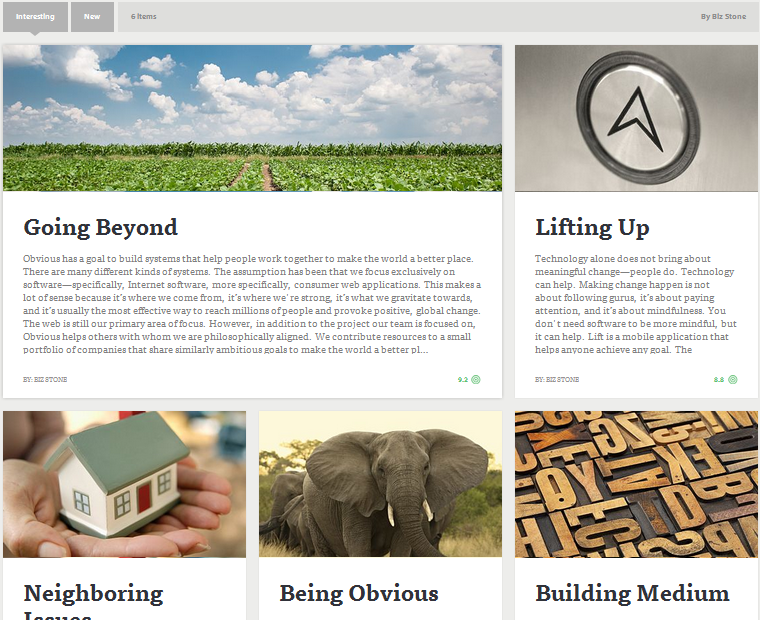
So far, every bit of content I’ve looked at reeks of authenticity. It’s genuine, excited and honest – many of the qualities that drive return visits to social sites in the first place. My favourite part has been the image sharing section, and I think it’s what will establish the niche Medium is seeking.
For instance, can you look at this and not smile?
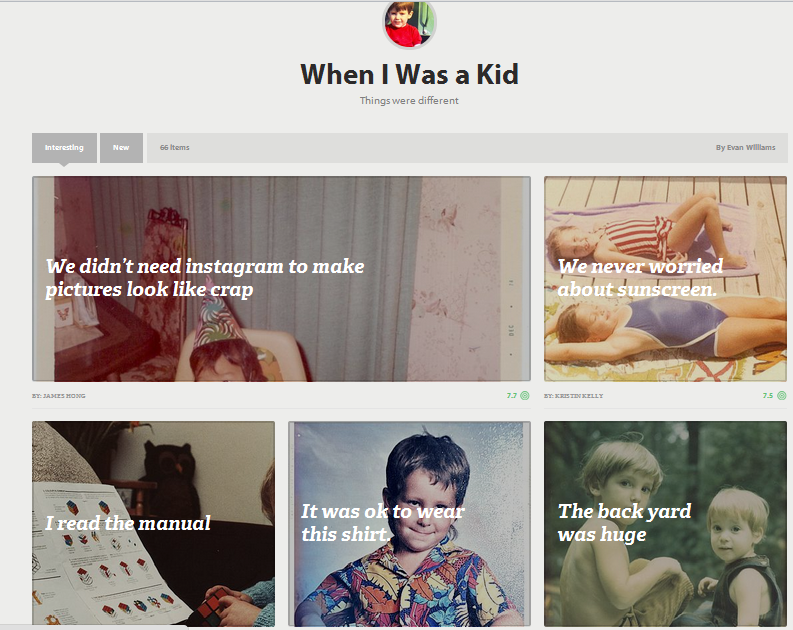
I not only want to read it, I want to be a part of it. It’s awesome, and funny, and a great reminder how far we’ve come in developing into a global collective. There’s no trolling (yet), no snark; just genuine glimpses into the lives of others, without the sort of behaviour that makes 4Chan such a cringe-worthy example of how not to be. There is a unique power is such a positive collective, and I am really excited about the possibility that Medium holds.
Can I be absolutely sure it stays this way? Of course not – it is the internet, after all. But I’m keeping an eye on it through my twitter account (@infinitesass), and believe me when I say I’ll be reporting on it again. I just have to go find some pictures from my childhood first.
SEO is a complicated issue for many small businesses. A lot of owners approach me looking for help, but due to time or financial constraints, can’t afford a consultant. I get that; having come from a start-up background, I am empathetic to the complications that arise from entrepreneurship.
Having said that, here is some straightforward advice for people attempting their own website optimization. Am I going to give you a blow by blow account on how to do this? No, because it’s not that simple. SEO needs vary from site to site; what works for an e-commerce site may not work for a NFP’s webpage, or a blog. What I will do is point out some of the less than obvious issues that are frequently overlooked by noobs. Here are some tips and advice for those considering it, or already in the process.
1. Understand the basics
Contrary to popular thought, SEO is not a process of manipulating the internet, but rather positioning your site to be efficient for search engines to process and cache. It is essential that you understand how the internet works before you can positively affect your search engine results.
You must understand how the bots spider your page – it’s not like how you and I read from left to right. Understanding how the page is segmented and approach should help you determine the most effective set up, and ideal locations for keywords, etc.
Also consider how pages are rated and ranked by search engines (S.E.s). Knowing what the S.E.s expect from quality pages will help you prioritize the work you do on the site, both in the front and back end. A large piece of this has to do with keywords and research. Which brings me to….
2. Research – it’s not just for students
SEO is not something that requires just a couple of hours of attention: It takes time, research and consistent attention to truly bring results. If you believe three hours of work once a month is really going to work, you are gravely mistaken.
When it comes to research materials, timeliness is increasingly important. What worked two years ago may not work now (thanks Penguin and Panda!); is it is important that your research materials be recent if you’d like to affect real change.
3. What the hell is a Keyword?
It’s disturbing how often I am asked this by entrepreneurs who think they’re doing an excellent job in SEO. A keyword is a specific word that you want to use, that is targeted by searchers, and thusly the bots completing the searches.
Throwing a bunch of random words or links onto your page might have worked before, but the internet is a funny thing – and it is in a constant state of flux. Do some keyword research: That includes looking that the trends surrounding that word, or the search habit of the people or area that you business should be targeting. There are some great, free or low-cost software out there that will let you do this.
4. Don’t overestimate Metric turnaround and underestimate popular media – use it to your advantage
Sorry to be the bearer of bad news, but adjusting keywords and structure will not result in an instant explosion of traffic or conversions. Generally, you won’t see real results in your metrics for at least six months. To expect more is unrealistic, so learn to be patient.
Use this time to your advantage: it will allow for deeper research, and more time to generate traffic through social media, mobile apps and referential media. All of these are essential in the current landscape, and will help you generate organic links (essential) while creating genuine interactions with others. These could even be considered marketing initiatives, so keep it in mind when you’re establishing your marketing tactics and scheduling your time.
5. Under-valuing the time investment in SEO
I get it: working in a small business means time is critical. But devoting a small portion of your month to SEO just isn’t going to cut it. Although it may seem like an unrealistic amount of time, integrating 30-90 minutes per day into your work schedule for SEO/Marketing initiatives would improve your search engine results whilst increasing your ROI. The bright side: this includes Facebook, Twitter, Pinterest, Yelp and other emerging social apps: all essentials in your marketing plans.
Facebook Click Fraud and the State of Cyberlaw
Air Date: August 2, 2012
Facebook Click Fraud? Jim and guest host Miranda Miller from Search Engine Watch welcome Brian Carter for a discussion about Facebook advertising.
In the second segment, lawyer, WebmasterRadio.FM host, and Internet Law Center founder Bennett Kelley also joins us to discuss the state of cyberlaw in the United States.
Podcast: Play in new window | Download
Comparing Google Penguin and Panda: Drops in Rankings
Air Date: July 25, 2012
With a new update to Google’s Panda algorithm being reported in search marketing circles, we thought it would be a good time to offer a refresher course in the dynamic duo of Google’s Penguin and Panda algorithms.
Our goal was to differentiate the significance of the drops in ranking that the Penguin and Panda algorithms have created and offer whatever advice we can to webmasters as the new update rolls forward.
Podcast: Play in new window | Download
Digital Always Media partner Alan K’necht speaks at the MTL140 social media conference in an evolving speech titled, “Measuring Your Social Fire”.
Jul 12
23
What’s A Guru?
 A popular and often self-proclaimed title commonly used to define individuals “in the know” is the word guru. The word congers up a variety of images ranging from an old man sitting on a mountain top with the answers to the meaning of life to a person who has spent a lifetime in their chosen field learning all there is to learn and who now shares their insight and wisdom with their peers and with those who have chosen to follow in their footsteps.
To understand my take on what the term guru means today, lets first start with the official definition of a guru:
Noun – (in Hinduism and Buddhism) A spiritual teacher, esp. one who imparts initiation (Oxford Dictionary).
Yet, today this term is being applied to people of all ages, who yesterday didn’t know what a meta tag was and today call themselves a SEO’s Guru or someone who signed-up for a Facebook account last month and calls themselves a Social Marketing Guru.
Over the past 3 years or so, the title of guru has been evoked so much that not only has it lost its luster, but when I people and many others hear that term now, we envision something completely opposite to the “spiritual teacher”. When occasionally when someone try to bestow that title on me, I deflect it and prefer something similar to experienced or subject matter expert.
During a recent TwitterChat, I was pressed to come up with my definition of what the term “guru” implied to me. I quickly thought of it as an acronym and tweet out the following:
G.U.R.U. = Great Uneducated Retarded Unit
This tweet garnered lots of attention and retweets. I pondered the tweet overnight and the next morning I came up with and tweeted out:
G.U.R.U. = Grossly Untrained Retarded Unaccountable
Of course in the on-line social world today, others responded with their own meanings. Here are three of the best:
G.U.R.U. = Greatly Underestimates Real Understanding (Louise DiCarlo @LovelyLu)
G.U.R.U. = Greatly Unverified Rhetoric (and) Unashamed (Dave Kragenbrink @dkragen)
G.U.R.U. = Grossly Under-qualified Really Unimaginative (Matthew Shepherd G+)
Which one do you like best? Do you have your own? Please share!

Get a free chapter from Alan K'necht's "The Last Original Idea"
The Last Original Idea actually is an original idea - highly unusual in a world where "recycle" is the order of the day. It takes a light hearted look at the state of Internet marketing today and traces back each of the elements to its historical roots, clearly demonstrating that companies who understood the mistakes of the past were able to be profitable in the present. Others are a mere memory, lost in cyber-space.
Catch US
 Save 20% on registration fees by using the special discount code of rc-3873420 courtesy of Digital Always Media